(1 votes, average: 5.00 out of 5)
 Loading...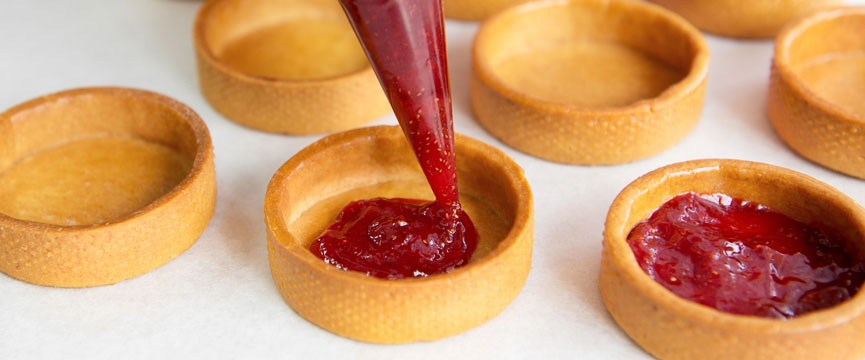
 In the Horeca sector and in industrial pastry making, ingredients must not only provide exceptional flavor, but also impeccable technical performance. At Lazaya, we know that the success of a creation depends not only on the recipe, but also on choosing the precise ingredient for the professional’s intended purpose; in this case, jams for baking.
A very common mistake is to use the same fruit jam to all preparations, but it’s important to understand that, depending on the jam chosen, its behavior in response to temperature changes and its interaction with other textures varies considerably. In this post, we’ll analyze, from a technical perspective, how to select the best jams for each application, guaranteeing results that will stand out in the display case and impress customers.
Table of Contents
The importance of choosing the right jams for baking: technical aspects
When a chef or pastry chef designs a dessert, they evaluate factors that go far beyond flavor. For example, aspects such as water activity, Brix levels, the type of pectin used, and acidity. These values determine whether a jam will withstand the high temperatures of an oven without boiling, whether it will maintain its shine in the cold of a refrigerator, or whether it will soak through and ruin a pastry. Let’s look at each of these aspects in more detail:
- Brix degrees (°Bx): It determines the soluble solids content and affects texture, sweetness, and stability.
- Water activity (Aw): It is key to controlling the migration of moisture into masses and fillings.
- pH and acidity: They influence gelation and microbiological stability.
- Type of pectin: It affects the heat resistance and firmness of the gel.
- Viscosity and rheological behavior: They determine the ease of dosing and stability in application.
Types of jams for baking
Pastry jams are not simply fruit preserves; they are high-precision technical formulations designed to solve specific problems on the production line or at the plating table.
That’s why it’s important to use the right jam at the right time, depending on the type of preparation the professional is doing; this ensures consistency between batches, stable behavior in industrial processes, and consistent results in the final product.
Jams for filling
Using jam as a filling, whether in tarts, croissants, muffins, chocolates, or cookies, presents the greatest technical challenges. Here, the product is encased within a mold (such as pastry dough or a sponge cake) and is usually subjected to a subsequent baking process; therefore, this jam must have good thermal stability and control over syneresis.
Behavior in oven and dosing machinery
The critical factor for a filling is heat stability (resistance to baking). If we use a standard jam to fill a pastry that will be baked at a temperature between 180°C and 200°C, the water in the jam will boil. This will cause the filling to expand, break the pastry, overflow, and, upon cooling, leave a hollow interior and an aesthetically unacceptable product.
To avoid this, jams intended for pastry fillings should be made with heat-resistant pectins and a strong gel structure. The technical recommendations for optimal fillings are:
- Humidity control: The jam should not exude water. Moisture transfer from the filling to the pastry will soften the sponge or ruin the crispness of the puff pastry. Therefore, jams with a controlled water activity are recommended.
- Mechanically stable texture: In high-volume workshops, the jam must be able to pass through nozzles and injector or dosing machines without its gel structure breaking down and without clogging the machinery, which often requires perfect sieving or millimeter-sized pieces of fruit.
Jams for topping
The topping on a cake, cheesecake, or individual pastry serves a dual purpose: protecting the product from oxidation and dehydration, and providing a high-end visual finish. In this case, heat stability is not critical, but surface gelling and transparency are essential. Therefore, these jams must offer exceptional shine, spreadability, and a clean cut.
Avoid opacity and ensure adhesion
The result of a good coating on the final product should be a glossy, inviting appearance. From a technical standpoint, coatings require a slightly different Brix level, often between 50 and 60, or formulations that allow them to be diluted in water or syrup for hot application (using a spatula or spray gun) and that gel quickly upon cooling.
It is important to keep these aspects in mind to achieve a professional finish:
- Clean cut: When slicing a cake, the topping jam shouldn’t drag with the knife or create stretchy strands. It should offer a clean cut that maintains the perfect presentation of the portion, something vital in Horeca hotel buffets.
- Extensibility and adhesion: The product should flow easily to create thin, even layers, but it should have enough stickiness so that it doesn’t run down the sides of the cake.
- Transparency and absence of lumps: The texture should be completely smooth and translucent to reflect the light, thus enhancing the visual impact in the display case.
Jams for serving
When we move beyond the purely pastry realm and into savory cuisine, premium breakfast buffets, or cheese boards, jam takes on a different role. As an accompaniment or pairing, jam doesn’t undergo harsh heat treatments or require stabilizing other structures; here, the product is presented “naked” to the customer, allowing its organoleptic qualities and texture to take center stage.
The perfect pairing in gastronomy and premium breakfasts
To accompany game meats, foie gras, pâtés or a selection of aged cheeses, professional chefs look for more complex flavor profiles, where the natural acidity of the fruit balances the fat of the main dish.
In these applications, professionals look for:
- Fruit integrity: Unlike injected fillings or smooth coatings, the visual and tactile presence of fine pieces of fruit, whole or diced, is highly valued in the accompaniment. This conveys craftsmanship and premium quality.
- Sweetness balance: Excessively high Brix levels can mask the flavor of a delicate cheese or overwhelm the palate at breakfast. Jam should enhance the authentic flavor of fresh fruit, offering a balanced and elegant taste experience.
- Spoonable texture: The product should easily yield to the spoon and maintain its volume on a piece of toast or a portion of cheese, without immediately spreading like syrup and without the rigidity of a hard gelatin.
Why choose Lazaya jams for baking
Professionals often ask themselves these questions before choosing the perfect jam for their creations:
- Will it be baked or applied cold?
- Do you need freeze resistance?
- Does it require automatic dosing?
- Should it have visible pieces or a smooth texture?
- What is the right sweetness profile for the customer?
In Lazaya’s catalog, you’ll find a complete range of jams for baking and professional applications. All with detailed technical data sheets to help you choose the right one. Choose from ovenproof, injectable, or spreadable jams; sieved or pureed; with or without sugar; with different Brix levels; and a variety of flavors. Such as blackberry, kiwi, orange, peach, raspberry, apricot, apple, or strawberry.
Working with a specialized supplier ensures that every batch performs exactly the same. In your ovens and display cases, optimizing your team’s time. A poorly chosen jam can lead to waste, stability issues, and a poor presentation. Therefore, if you want to increase profitability, achieve consistent results, and streamline processes. We recommend always choosing suppliers with high-quality, guaranteed products.
At Lazaya Preserved Fruit, for over eight decades, we’ve been developing solutions designed for professionals. Those who want to delight their customers with perfect textures and authentic flavors. Discover our range of jams and transform every filling, topping, and accompaniment into a unique experience that elevates your culinary offerings. We’re here to help. Contact us for further information.