(1 votes, average: 5.00 out of 5)
 Loading...
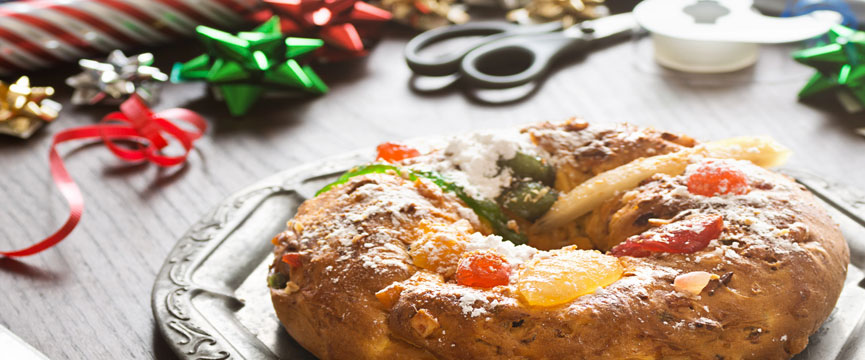
 Christmas is a time full of culinary traditions passed down from generation to generation. Among the most representative sweets of this holiday season, the Roscón de Reyes occupies a privileged place and, without a doubt, every January 6th is the absolute protagonist of breakfasts, snacks and family gatherings.
Its characteristic crown shape, its spongy dough, the unmistakable aroma of orange blossom water and, especially, the colorful candied fruits that decorate its surface make this sweet a symbol of Christmas.
But what is the origin of the Roscón de Reyes? Is it eaten the same way in other countries? Why has candied fruit become one of its most characteristic ingredients? In the following lines, we’ll answer these and other questions that many people have about the Roscón de Reyes. Stay with us to learn more about this magnificent dessert.
Table of Contents
The origin of the Roscón de Reyes: a tradition with centuries of history
Although today we associate the Roscón de Reyes with the Christian festival of Epiphany, its origins are usually linked to much older celebrations.
One of the most widespread theories places its origins in the Roman Saturnalia, festivals dedicated to Saturn, the god of agriculture, during which cakes made with honey, nuts, and figs were consumed. Some traditions also included a bean hidden inside, associated with luck and prosperity.
However, the evolution of those celebrations into the current Roscón is not fully documented. What we do know is that for centuries the custom of sharing a Three Kings’ Day cake with a bean inside became established in France. This tradition later spread to other European countries, including Spain, where the sweet treat acquired its current characteristics.
During the 19th century, the Roscón de Reyes began to become popular in our country and, at the beginning of the 20th century, we already find recipes that incorporated such characteristic ingredients as orange blossom water and candied fruit.
Over time, figurines were added to the traditional bean and new fillings appeared, such as cream, pastry cream or truffle.
This is how the Roscón we know today was born: a sweet treat that combines history, tradition and a decoration reminiscent of the jewels of a royal crown.
The Three Kings’ Cake and its different versions around the world
The tradition of sharing a sweet treat during Christmas and Three Kings’ Day celebrations is not unique to Spain. Many countries have similar traditions, although each culture has developed its own recipes. Let’s take a closer look:
Spain: Roscón de Reyes
The Spanish Roscón is made from a fermented dough, enriched with butter, eggs and sugar, and usually flavored with orange blossom water and citrus fruits.
Its surface is decorated with sugar, almonds, and candied fruits of various colors. Cherries, orange slices, and green or red fruits create a presentation reminiscent of a crown adorned with precious stones.
Portugal: Bolo Rei
Bolo Rei is one of the most characteristic sweets of Portuguese Christmas. Its circular shape is reminiscent of the Spanish Roscón, although its dough usually incorporates raisins, nuts, and, in some recipes, port wine.
Candied fruits play a major role, both inside the dough and in its exterior decoration.
France: Galette des Rois and Gâteau des Rois
In France, various traditions coexist. In much of the country, it is common to eat Galette des Rois, made with puff pastry and filled with almond cream.
However, in the south of France we find the Gâteau or Couronne des Rois, much more similar to the Spanish Roscón: a crown of brioche-type dough, flavored with orange blossom and decorated with candied fruit.
México: Rosca de Reyes
The tradition of the Roscón arrived in Mexico from Spain and evolved to become one of the most representative sweets of Three Kings Day.
The Rosca de Reyes is usually decorated with candied fruit, figs, and strips of sugar paste. Hidden inside are small figurines of the Baby Jesus. According to tradition, whoever finds one of these figurines is responsible for providing tamales on Candlemas Day, February 2nd.
Italy, Germany and the United Kingdom: other Christmas traditions with candied fruit
Although they are not versions of the Three Kings’ Cake, these countries also maintain an important tradition of Christmas sweets made with fruits preserved in sugar.
In Italy, Panettone stands out, its traditional recipe incorporating raisins and candied citrus peel. In Germany, certain varieties of Stollen include candied fruit, raisins, and nuts. In the United Kingdom, Christmas Cake combines dried and candied fruit with spices and other ingredients.
They all demonstrate that candied fruit is one of the great common elements of international Christmas confectionery.
The ingredients of the Roscón de Reyes: a combination of tradition and flavor
The secret to a good Roscón de Reyes begins with the quality of its ingredients and careful preparation. The traditional recipe uses strong flour, eggs, milk, sugar, butter, and yeast. Aromas such as orange blossom water and orange and lemon zest are added to these ingredients, contributing significantly to its distinctive character.
Kneading and proper fermentation result in a tender and spongy texture, while baking gives it its characteristic golden color.
But there is another ingredient that is essential to recognizing a Roscón at first glance: candied fruit. Along with almonds and sugar, the brightly colored fruits that decorate its surface have become one of its most recognizable hallmarks.
Candied fruit: much more than a decoration
As we know, candied fruit plays an essential role in the Roscón de Reyes. Besides adding color, it introduces nuances of flavor, texture, and sweetness that complement the characteristics of the dough.
Traditionally, the arrangement of the fruit on the Roscón is interpreted as a representation of the precious stones adorning a royal crown. In this way, the red, green, and orange hues help transform this sourdough bun into a readily recognizable festive treat.
But its function is not merely decorative. The candied fruit adds a pleasant and juicy texture that contrasts with the sponginess of the ring-shaped cake and enriches each slice.
What candied fruits are commonly used in the Roscón de Reyes?
Among the candied fruits most commonly used in the preparation of roscones are:
- Candied cherry: One of the most traditional ingredients. Its deep red color and sweet flavor provide a very attractive visual contrast. It can be used whole or in halves.
- Candied orange: Presented in discs or strips, it provides a citrus aroma that combines especially well with orange blossom water and the dough of the roscón.
- Candied pumpkin: They use it red or green, in various presentations. Its texture and mild flavor make it ideal for eye-catching decorations.
The combination of these fruits allows for the creation of balanced compositions, adapted to both traditional ring-shaped cakes and the most innovative proposals from pastry professionals.
How is candied fruit made?
Candying is a preservation technique that has been used for centuries and allows fresh fruit to be transformed into a long-lasting ingredient, maintaining a characteristic texture.
The process involves gradually replacing some of the water contained in the fruit with the sugars from a syrup. To achieve this, the fruit undergoes successive stages of candying in which the concentration of the syrup is gradually increased. This gradual increase is essential, as it allows the sugars to penetrate the fruit without excessively damaging its structure.
The result is a fruit with a firm and juicy texture, a characteristic sweetness and good preservation properties.
When it comes to fruit used to decorate Three Kings’ Day cakes, achieving a uniform appearance, attractive colors, and proper behavior during baking is also important. Therefore, selecting the right raw materials, controlling the baking process, and choosing the appropriate cut are essential aspects for obtaining a quality product.
Lazaya Preserves: Tradition and Experience in Candied Fruit for Christmas
At Conservas Lazaya, we have been working with fruit since 1940, combining the experience accumulated by different generations of our family with modern manufacturing and quality control technologies.
From our facilities in Calatayud, Zaragoza, we produce a wide variety of candied fruits intended for professionals in the bakery, pastry and food industries, both in Spain and in international markets.
Our range of candied fruit for Christmas is specially designed to facilitate the work of bakeries and achieve attractive and consistent presentations. Among our specialties are candied orange discs and half-discs, as well as whole or halved candied cherries, available in different colors and finishes.
The selection of the fruit, the control of the candying process, and the variety of formats allow us to offer solutions tailored to the needs of each professional. We know that behind every Roscón de Reyes there is much more than a recipe: there are hours of work, pastry experience, and a tradition that deserves to be preserved.
Candied fruit, an ingredient that keeps the Christmas tradition alive
Over the centuries, Christmas recipes have evolved, incorporating new ingredients, flavors, and presentations. However, candied fruit continues to hold a special place in some of the most iconic sweets of this time of year.
From the Spanish Roscón de Reyes to the Portuguese Bolo Rei or the Italian Panettone, their presence reminds us that gastronomy is also a way of transmitting culture and tradition.
At Conservas Lazaya, we continue working to ensure that candied fruit remains a part of those special moments, offering professionals products that combine tradition, quality and versatility.
When Christmas arrives, there are flavors and colors that should never be missing.
Discover our range of candied fruit for Christmas and find the most suitable format for your recipes.